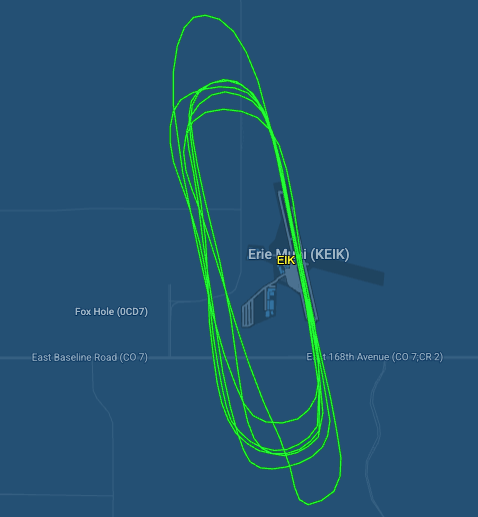
ERIE, CO – Two people were killed Saturday afternoon when their light sport aircraft crashed while practicing landings at Erie Municipal Airport (KEIK). Federal investigators are now pointing to challenging weather conditions and a potential loss of control during a go around maneuver. Flight aware also shows how many successful patterns were flown the same day before the accident.
The aircraft was a JMB Aircraft VL-3 Evolution with the tail number N594TT which was substantially damaged but appeared to be in a single piece just off the runway.
According to a preliminary report based on ADS-B data the crash occurred during the pilots’ sixth touch-and-go attempt on runway 33. It appears the aircraft lost control during an attempted go around.
The wreckage came to rest upright just 190 feet from the runway. The entire airplane was located at the crash site with its wings and tail still attached to the airframe with no post crash fire. Winds were gusting to 15 knots from the west creating a significant crosswind of approximately 11.5 knots for their landing attempt. Although that cross wind factor might have been manageable it would have been challenging especially if the pilot wasn’t well prepared for landings and takeoffs in heavy cross winds.
Adding to the difficulty would have been the density altitude of 7,400 feet at the time which significantly reduces an aircraft’s engine performance and the wings ability generate lift, possibly inducing an early departure stall at low speeds.
Takeaways
Speed: Pilots should adjust landing and departure speeds in high winds in case of gusts which are not advantageous to conditions. Just as you would add some speed on approad in heavy winds, the same can be done on departure in ground effect.
Control Corrections: On a go around it’s good to anticipate the added forward pressure you will need to add when adding full throttle. If you are trimmed for approad anc lower speeds you will likely be trimmed back with nose high but this will pitch the nose high if full throttle is applied, be ready to handle this and trim pressure out. If this is not done the nose can overpitch high and cause a stall to the AOA being exceeded.
It will be sometime before we know exactly why this crash happened but it’s a good reminder to stay proficient and fly in the conditions you trained for.